

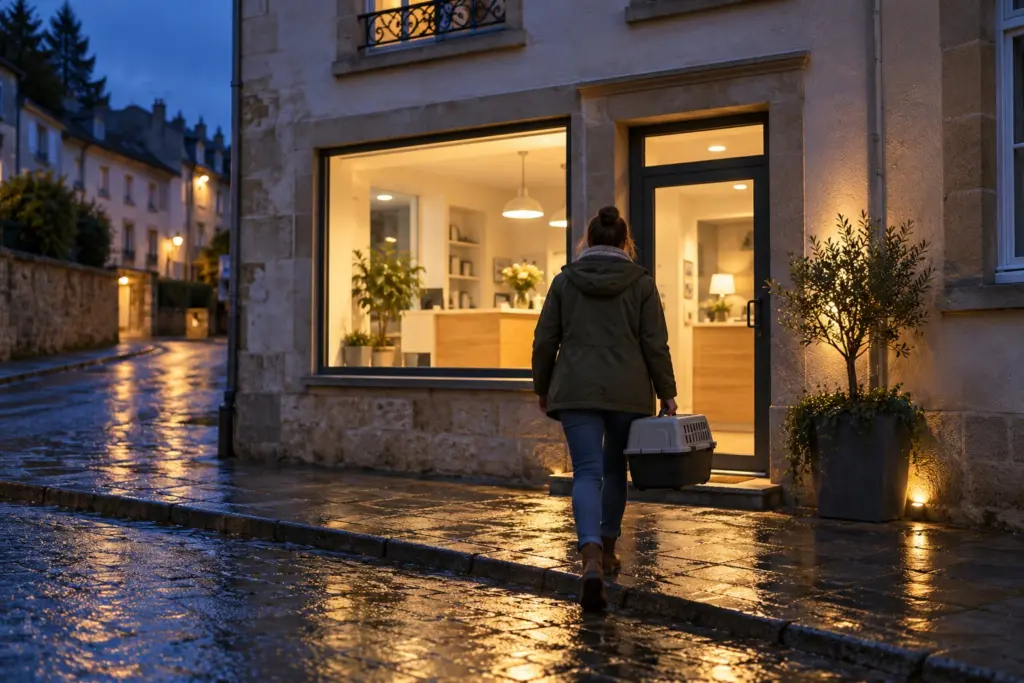
Most health worries are perfectly fine to bring to the next morning’s consultation. A few get worse within minutes or a couple of hours, and those are what Luxembourg’s out-of-hours service for small animals exists for.
A simple rule of thumb: if breathing, consciousness, circulation, passing urine or a birth is involved, do not wait. Call, and let someone assess it over the phone. A call that ends with “that can wait until tomorrow” is never wasted.
Signs that should not wait until morning
If you see any of the following, contact a practice or the on-call service immediately:
- Breathing trouble: fast, noisy or laboured breathing, neck stretched out, a cat breathing with its mouth open, pale or bluish gums.
- A male cat going back to the litter tray again and again and producing no urine, or only a few drops. A urinary blockage is life-threatening.
- A dog with a swollen, tight belly, retching without bringing anything up, drooling heavily and unable to settle.
- Suspected poisoning: human medicines, cleaning products, antifreeze, rat or slug poison, chocolate, sugar-free sweets or an unknown plant.
- Heatstroke: heavy panting, unsteady walking, restlessness and then dullness after exercise, hot weather or time in a car.
- A seizure lasting more than a couple of minutes or repeating shortly afterwards, a collapse, loss of consciousness, very cold ears and paws.
- Birth trouble: strong contractions with nothing being delivered, very long gaps between newborns, dark or greenish discharge with no birth.
- An eye injury, an eye suddenly held shut and watering, a cloudy cornea, or an eyeball out of its socket.
- Bleeding you cannot control, a road accident, a fall from a height, bite wounds: even a small puncture can go deep.
- Sudden weakness or paralysis of the hind legs, especially in cats, or clear pain with no obvious cause.
- Vomiting or diarrhoea that will not stop, with no water staying down. Puppies, kittens and small pets dehydrate quickly.
- A rabbit or guinea pig that has not eaten for a few hours and has stopped producing droppings.
- An allergic reaction: swollen face, hives on the skin, or sudden weakness after an insect sting.
Do not give anything from your own medicine cabinet and do not make your animal vomit unless a vet explicitly tells you to. Instead, take the packaging, the label or a piece of the plant with you.
How the out-of-hours service works
The small-animal on-call service runs from 08:00 to 08:00 the following morning. There is always an address responsible for emergencies, but it changes every day. Which practice is on duty is shown on the on-call list published by the Collège Vétérinaire; the LAK lists it under “GARDE” and the AMVL publishes it too.
Always call before you set off: the team can prepare, give you the exact address and tell you what to watch for on the way. If nobody answers, two further routes lead to the vet on duty: 112 and Post Infotel on 26 77 12 34. 112 is at the same time the general emergency number, so it is also the route when people are in danger too, after a road accident, say, or a serious bite injury.
Chip number, history, a number to call back
- Species, breed, approximate age and weight, neutered or not.
- The microchip number and the EU pet passport with the rabies vaccination entry.
- What happened and when, in one or two sentences, plus any known conditions.
- The packaging or a photo of whatever was swallowed, and a list of anything your animal has already been given today.
- A short video of the seizure or the breathing, if you could take one safely.
- Your location, a callback number, and which payment methods the on-call practice accepts.
For the drive: cats and small pets in a carrier, dogs on a lead, a towel underneath. Even a gentle animal can snap when in pain, so protect yourself without losing time over it.
If you often drive into Germany, Belgium or France, take the EU pet passport with you whenever you cross the border. Leaving it in the car permanently is a poor idea, it sits there through the summer heat. Across the border the local on-call service applies, and the passport records the chip number and the rabies vaccination.
Chip, rabies vaccination, liability insurance
Much of this is required in Luxembourg anyway, and it helps on the night it matters:
- Dogs: microchipped by a vet within four months of birth, and registered with the commune within four months.
- Dogs: rabies vaccination is compulsory from twelve weeks of age.
- Dogs: civil-liability insurance from an insurer licensed in Luxembourg is compulsory; proof is required at registration.
- Your vet issues the EU pet passport and records the chip number and the rabies vaccination in it.
- Cats: under the law of 27 June 2018 they must be electronically identified and registered, and cats with outdoor access must be neutered, farm cats excepted.
Dogs covered by the law of 9 May 2008 (Staffordshire bull terrier, Mastiff, American Staffordshire terrier, Tosa, and dogs without a recognised pedigree that are morphologically comparable to them) also need the handler certificate known as the “Hondsführerschäin”. For the exact steps, check with your commune.
Keep these documents in one fixed place and save your practice’s number in your phone. Nobody enjoys hunting for paperwork at three in the morning.
Frequently asked questions
How do I know it cannot wait until morning?
If breathing, consciousness, circulation, passing urine or a birth is involved, treat it as urgent. The same goes for suspected poisoning, heatstroke, an eye injury, heavy bleeding, or a male cat that cannot pass urine. When in doubt, call and let someone assess it.
Where is the on-call vet list published in Luxembourg?
The small-animal on-call service runs from 08:00 to 08:00 the next morning. The practice on duty appears on the on-call list published by the Collège Vétérinaire; the LAK lists it under "GARDE" and the AMVL publishes it too. Call before you set off.
Should I call 112 for my animal?
Yes, it is one of the official routes. To reach the vet on duty you can call 112 or Post Infotel on 26 77 12 34; the on-call list is also published by the Collège Vétérinaire and on amvl.lu under GARDES. The fastest way is still to dial the on-call practice directly from that list. 112 is at the same time the general emergency number, so it is also the route when people are in danger.
What should I bring?
The EU pet passport with the chip number and rabies vaccination, the packaging or a photo of anything swallowed, a note of known conditions, and a carrier or lead. A short video of a seizure or of laboured breathing helps the team judge the situation.