

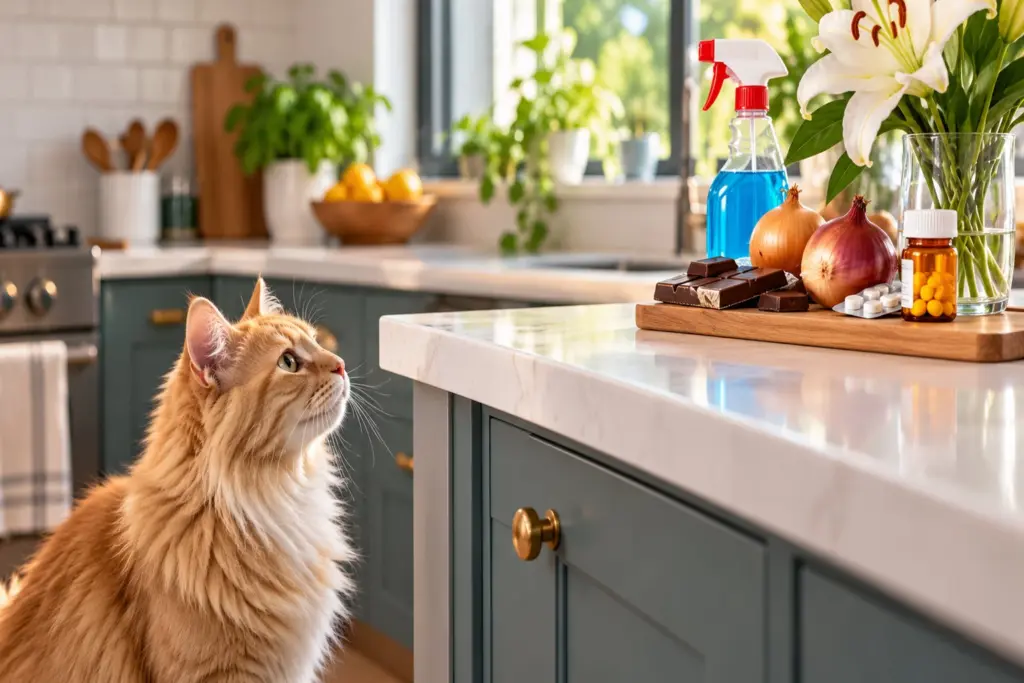
If you have any reason to think your dog or cat has eaten or licked something toxic, contact a veterinary practice immediately. Do not wait to see whether symptoms appear: with many substances the useful window is measured in minutes and hours, not in days. Outside normal opening hours, the small-animal out-of-hours service in Luxembourg runs from 08:00 to 08:00 the following morning, and the on-call list is published by the Collège Vétérinaire. 112 is the general emergency number; it is the route when people are in danger too. For the animal itself the veterinary out-of-hours service remains the address.
How serious a case is depends on the product and the amount, but also on your animal’s weight and age. That is not something to judge at the kitchen table. Phoning about something that turns out to be harmless is not a wasted call; your vet can assess the situation on the telephone in a couple of minutes.
Chocolate, tablets and anything labelled sugar-free
Most cases start in the kitchen, not the chemical cupboard. Chocolate is the classic: dogs break down one of its components poorly, and dark chocolate and cocoa powder are far more concentrated than milk chocolate. An Advent calendar within reach or a cake left to cool on the table is enough. Less well known is xylitol, a sweetener used in sugar-free chewing gum, mints, some peanut butters and baked goods; very small quantities can matter for dogs, so read the ingredients of anything labelled sugar-free. With grapes, raisins and sultanas nobody can predict the reaction, no amount can be treated as safe, and they hide in muesli, stollen and biscuits. Add onions, garlic, leeks and chives, whether raw, dried or cooked into leftovers, plus alcohol, coffee grounds, energy drinks and raw yeast dough.
Human medicines are almost as common a cause. A dropped tablet or a blister pack in a coat pocket is enough: dogs swallow first and think later. So is a bag left on the floor. Cats are more often affected by things applied to human skin and then licked off, and by nicotine products, from refill liquids to patches.
The garage, the garden and the bouquet on the table
Antifreeze and engine coolant taste sweet; a small puddle under the car is enough, for dogs and cats alike. Slug pellets, rodent bait, weedkillers and drain cleaners belong behind a closed door. Rodent bait also matters second-hand, if a cat catches a poisoned mouse, and in winter de-icing salt irritates paws that are then licked clean.
For cats, lilies deserve a paragraph of their own. Every part of the plant, the pollen and even the water in the vase can cause severe harm; a cat that merely brushes past a flower and later grooms the pollen out of its coat can be affected. In a household with cats the simplest approach is not to bring lilies into the house at all, and to check bouquets you are given. Also worth knowing: yew, oleander, dieffenbachia, autumn crocus, foxglove, azalea and daffodil. Fermenting windfall fruit and an open compost heap are an autumn classic with dogs.
The first minutes
When it has happened, the order is simple: first get your animal away from the source and secure any other pets, then pick up the phone.
- Call before you drive. Say what it was, roughly how much, how long ago, and how heavy your animal is, then ask where to go.
- Take the packaging, the label or the plant with you, or photograph them. The exact product name is often the single most useful thing you can bring.
- If your animal vomits by itself, take a sample along in a sealed container.
- If something is stuck to the coat or paws, stop the animal from licking it and ask on the phone how to clean it, rather than choosing a method yourself.
- Write down the time, and take the EU pet passport, which records the chip number and the rabies vaccination. A second person to hold the animal helps.
What you leave undone matters just as much.
Do not try to make your animal vomit on your own initiative, not with salt and not with a tip from a forum; some substances do more damage on the way back up, and salt is itself dangerous. Do not give milk, food or any human medicine, including leftovers from an earlier treatment. Do not wait for symptoms, do not put it off until morning because it is late, and do not spend twenty minutes searching online instead of making one call. And do not scold your animal: you need it to come to you and let you look in its mouth.
Cupboard shut, number saved
Prevention is unspectacular. Medicines in a closed cupboard rather than on the bedside table, bags off the floor, chemicals sealed, spills wiped up straight away, a bin with a lid. Save your practice’s number in your phone and note where the on-call list can be found, so that you are not hunting for both at 23:00.
And since trips to Germany, Belgium and France are part of ordinary life here, take the pet passport along when you cross the border. At an unfamiliar practice abroad it gives the team a first record of your animal, and a holiday house or an unfamiliar garden is new territory for your animal anyway.
Frequently asked questions
My dog ate something but seems completely fine. Should I still call?
Yes. With many substances the first signs appear only after several hours, while the useful time is right at the beginning. A short phone call establishes whether your animal needs to be seen.
Should I make my dog vomit before driving over?
No. Do not induce vomiting on your own initiative. Some substances cause more damage on the way back up, and home methods such as salt are dangerous in themselves. Let the practice decide.
My cat only sniffed a lily. Is that already a problem?
Treat any contact with a lily as a reason to call, including pollen on the coat and water from the vase. The practice can tell you whether your cat should be examined.
Who can I reach at night or at the weekend?
The on-call practices run a 24-hour service that starts at 08:00 and ends at 08:00 the next morning. To reach the vet on duty you can call 112 or Post Infotel on 26 77 12 34, and the on-call list is published by the Collège Vétérinaire and on amvl.lu under GARDES. Our own emergency page lists the ones on duty right now with their numbers. Call before you set off: the vet on duty may not be at the practice and has to get there too.