

An animal that flattens itself on the table, growls or refuses to be touched is not misbehaving. It is reacting to a situation it cannot interpret: unfamiliar smells, a slippery surface, other animals, hands holding it still. You rarely erase that fear completely, but you can prepare for it.
One exception before we get to training. Suspected poisoning, a bloated hard belly with retching that produces nothing, breathing trouble, heatstroke, a birth that is not progressing, an eye injury, or a male cat going to the litter tray again and again without passing urine: in those cases only speed counts. Contact a practice or the out-of-hours service immediately and save the rest of this article for another day.
Fear itself starts long before the growl. A dog pants without heat or exertion, turns its head away, yawns, licks its nose, suddenly goes still. A cat crouches low, pupils wide, ears flat, pressed into the back of the carrier. Many animals also refuse treats they would never normally leave. A quiet animal is not automatically a relaxed one; catching the early signs means you can act while your pet is still reachable.
Start weeks ahead, not on the morning itself
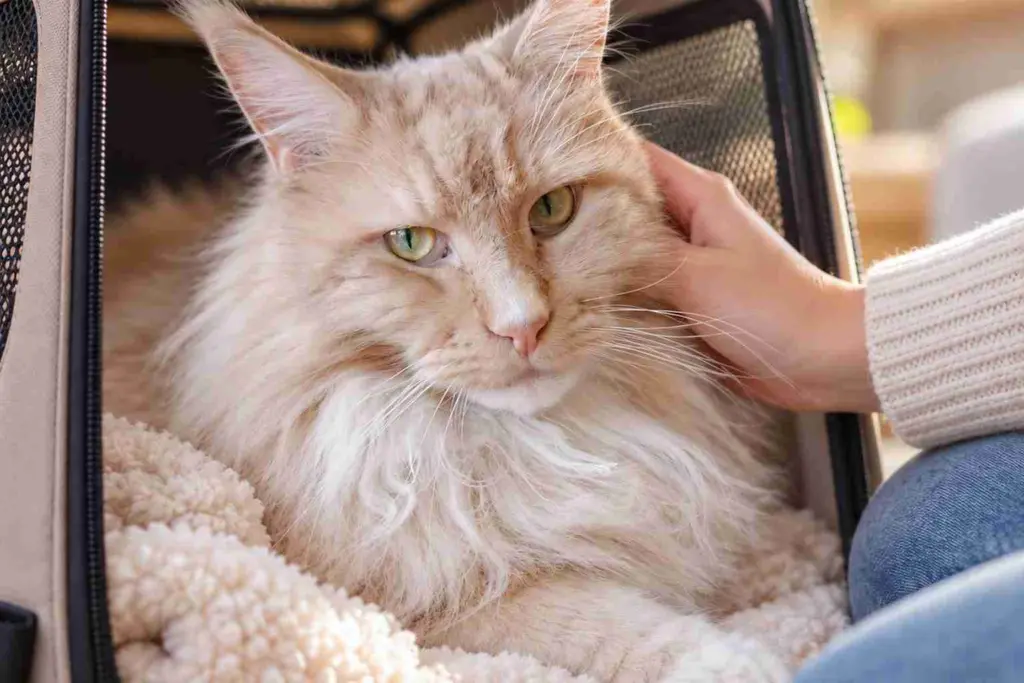
For most cats, the carrier only ever appears before something unpleasant. That can be turned around, but in weeks, not hours. Leave the carrier out permanently, door open, with familiar bedding inside, instead of fetching it from the cellar on the morning of the visit. Put food or a toy in it and leave the door open; the cat decides when to go in. A model with a removable top is worth looking for, because the cat can then stay sitting in the bottom half for part of the examination. Later, add short car trips that do not end at the practice. On the day, cover the carrier with a towel and carry it steady, with both hands.
With a dog, practise handling instead: touch paws, ears and muzzle briefly, then follow with something pleasant; ten seconds a day is enough. If the practice offers it, call in once with no treatment at all: walk in, stand on the scales, walk out again. Rabbits, guinea pigs and birds travel best in their usual container with familiar bedding; ask beforehand whether the companion animal may come along.
What to say when you book, and what to pack
Say it while booking, not in the waiting room; a team that knows in advance plans differently. Mention:
- that your animal is fearful, and what happened last time, including biting or scratching; that is not an admission, it is information;
- whether a quiet slot is possible, such as the first consultation of the morning, whether cats and dogs wait separately, and whether you can wait outside until you are called;
- what you have observed, since when, and whether your animal should eat beforehand;
- which language you would like to use: many practices in Luxembourg work in Luxembourgish, German, French, Portuguese or English, and a consultation you follow easily lowers your own tension, which your animal reads;
- whether your dog falls under the law of 9 May 2008, which lists the Staffordshire bull terrier, Mastiff, American Staffordshire terrier and Tosa, along with dogs without a recognised pedigree that are morphologically comparable to those breeds.
Into the bag goes the EU pet passport, issued by the vet, which records the microchip number and the rabies vaccination.
Why forcing it costs you the next visit
Animals learn remarkably fast from single, intense experiences. A cat tipped out of its carrier or a dog dragged across the floor does not simply have a bad afternoon; it forms an expectation for next time. Caution turns into panic, panic turns into defence, and the following appointment starts from a worse position than today.
If your animal shuts down, say so out loud. A pause, an examination on the floor instead of the table, or a second attempt on another day is not a failed consultation but an investment in every one that follows. What cannot medically wait, and how future appointments might be set up differently, is for your vet to judge. Do not pin your animal down yourself either, if the team suggests another way; your most useful role is usually the familiar voice at the head end.
When there is no time to practise
Emergencies ignore training plans. Outside opening hours, the small-animal out-of-hours service in Luxembourg runs from 08:00 to 08:00 the next morning. The on-call list is published by the Collège Vétérinaire, by the LAK under “GARDE” and by the AMVL; the general emergency number is 112. Phone before you set off, so the team knows what is coming. And everything you practised in calmer weeks, the open carrier, the hands on the paws, the short car ride, is exactly what helps on a day like that.
Frequently asked questions
My cat only goes into the carrier if I push her in. What can I do differently?
Leave the carrier out permanently with the door open and familiar bedding inside, and feed her in it without closing the door. This takes weeks, not hours. If the appointment is urgent, say when booking that loading the cat is difficult, so the team can allow more time.
Should I tell the practice that my dog has snapped before?
Yes. With that information the team can plan the time, the environment and the handling differently. An incident kept quiet is more likely to lead to a situation that upsets everyone, the dog included.
Can the practice do anything to make an anxious animal calmer?
Raise it during the consultation. Your vet can assess what is possible in your case and how future appointments might be prepared differently. That decision is made at the practice, not something to attempt on your own at home.
Who can I reach at night or at the weekend?
The on-call practices run a 24-hour service that starts at 08:00 and ends at 08:00 the next morning. To reach the vet on duty you can call 112 or Post Infotel on 26 77 12 34, and the on-call list is published by the Collège Vétérinaire and on amvl.lu under GARDES. Our own emergency page lists the ones on duty right now with their numbers. Call before you set off: the vet on duty may not be at the practice and has to get there too.