

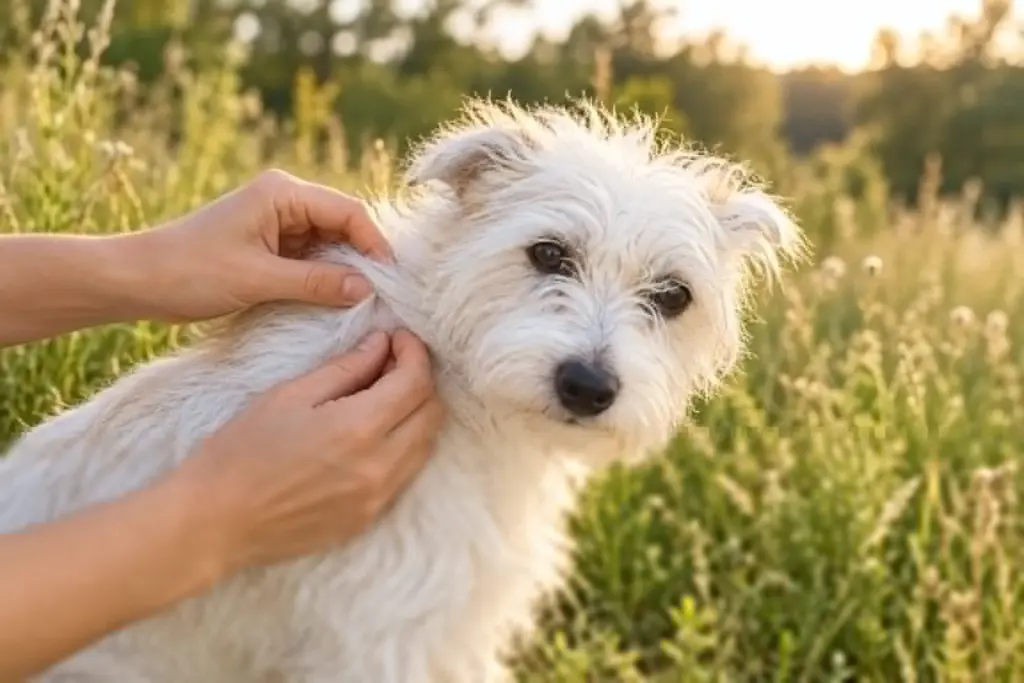
Anyone who walks a dog in Luxembourg or lets the cat out knows the scene: back from a stroll along the woodland edge, and a tick has settled into the coat. Ticks are no longer a summer-only subject. They wake up as soon as it stays mild for a few days in a row and only retreat during a sustained frost, so in a mild winter one can turn up in January. Fleas never really pause: a heated home suits them all year, with a clear rise in late summer and autumn. Worms follow daily life rather than the calendar. Hunting, digging in soil, plenty of contact with other animals, or simply being young all push the risk up.
What cannot wait
Before we get to ticks, the important part. Suspected poisoning, breathing difficulty, a distended hard belly with unproductive retching, heatstroke, a birth that stalls, an eye injury, or a male cat straining again and again without passing urine: call a practice or the on-call service immediately. Do not wait for the next free appointment. The small-animal out-of-hours service runs from 08:00 to 08:00 the next morning; the on-call list is published by the Collège Vétérinaire, by the LAK under “GARDE” and by the AMVL. The general emergency number in Luxembourg is 112.
The check after a walk
n
Back to everyday life. A thorough check takes two to three minutes and works best straight after you get home, while a tick is often still crawling and has not attached. Run your fingertips through the coat against the lie of the hair and feel for small bumps; on a dark or dense coat, a lamp helps. Ticks head for thin, warm skin, so these spots deserve a close look:
- head, lips, ear flaps and behind the ears
- the neck, including under the collar
- armpits, chest, belly and groin
- between the toes and around the pads
- the base of the tail and the area beneath it
Fleas themselves rarely show their faces. What gives them away is dark grit in the coat: comb with a fine flea comb over damp white paper, and if the grit turns reddish-brown, that points to flea dirt. Frequent scratching or nibbling at the tail base fits the same picture.
Found a tick? Here is how it comes off
The sooner a tick comes off, the better.
n
- Have fine tick tweezers, a hook or a tick card within reach. Ordinary cosmetic tweezers squeeze the body too easily.
- Place the tool as close to the skin as you can, at the mouthparts rather than the engorged body.
- Pull calmly and steadily. With a hook, follow the direction of rotation the instructions give.
- Look at the bite site.
- Jot down the date and the spot on the body. The little note feels like overkill, and at the next appointment it earns its keep.
- Dispose of the tick in tape or a closed container.
- Wash your hands.
n
None of this belongs on the skin
Oil, glue, alcohol, nail varnish and heat have no business on the skin. Home tricks like that only irritate the tick.
If a small dark remnant stays behind, do not dig for it. The skin often pushes it out on its own; if the site becomes inflamed, have it looked at. A tick on an eyelid or inside the ear flap, or an animal that puts up a real fight, is a job for the practice.
When to call the practice
Most tick bites come to nothing. Even so, watch your animal for a few weeks and get in touch if something is off:
- fever, dullness, a clearly reduced appetite
- new lameness, or lameness that shifts from leg to leg, swollen joints
- a bite site that grows, turns hot or weeps
- pale gums, dark urine, tiring unusually fast
- intense itching, bald patches, scabs, especially just in front of the tail
- weight loss despite a good appetite, a dull coat, diarrhoea, vomiting, a pot belly in puppies and kittens
On the phone, give the age and weight, say how long you have noticed it and whether the animal has been abroad. In the Greater Region, where a trip to Belgium, Germany or France barely counts as travel, that detail matters. Do not treat on your own initiative. Something meant for another species, or for people, can be dangerous.
Passport and parasite cover at the same appointment
Take the passport along whenever you cross the border, and use the same appointment to agree which parasite protection suits your animal’s species, age, weight and daily life.
Frequently asked questions
When does tick season peak in Luxembourg?
There are usually two waves: one in spring and one from late summer into autumn. In mild winters ticks stay active in between, so a regular check is worthwhile all year.
What if part of the tick stays in the skin?
Do not dig for it. The skin often pushes the remnant out on its own. If the spot turns red, swollen or painful, have it examined at a practice.
Do I need an appointment after every tick bite?
As a rule, no. Note the date and the spot, then watch for a few weeks. Call if you see fever, dullness, lameness or loss of appetite.
Who can I reach at night or at the weekend?
The on-call practices run a 24-hour service that starts at 08:00 and ends at 08:00 the next morning. To reach the vet on duty you can call 112 or Post Infotel on 26 77 12 34, and the on-call list is published by the Collège Vétérinaire and on amvl.lu under GARDES. Our own emergency page lists the ones on duty right now with their numbers. Call before you set off: the vet on duty may not be at the practice and has to get there too.