

In Luxembourg, crossing a border is rarely an expedition. A Saturday market in Arlon, Sunday lunch with family in Thionville, and the dog usually comes along. That is exactly why the EU pet passport is an everyday document here rather than a holiday formality.
The passport is issued by your vet. It records your animal’s microchip number and its rabies vaccination, and because everything in it hangs on the chip, the chip has to stay readable. If your animal has not been scanned in a while, ask at the next appointment; it takes seconds. Your practice can also explain how the passport is kept up to date later on.
What comes before the passport in Luxembourg
For dogs the order is fixed:
- the microchip, within four months of birth
- registration with your commune, also within four months
- rabies vaccination, compulsory in Luxembourg from twelve weeks
- civil-liability insurance with an insurer licensed in Luxembourg, with proof required at registration
Once the chip is in place and the rabies vaccination recorded, your vet can issue the passport.
If your dog falls under the law of 9 May 2008, meaning a Staffordshire bull terrier, Mastiff, American Staffordshire terrier, Tosa or a dog morphologically comparable to such breeds without a recognised pedigree, the Hondsführerschäin comes on top. Find out well before departure how your destination handles such dogs; for the Luxembourg side, your commune can tell you.
Cats must be identified and registered under the law of 27 June 2018, and cats with outdoor access must also be neutered or sterilised, farm cats excepted. As for what paperwork your cat needs to travel, ask your practice.
From the Saturday run to the longer trip
For the short hop to Trier or Arlon, a small routine has proved its worth:
- the passport travels with you, not in the glove box and not in a drawer at home
- the details on the tag are current, including a mobile number that works abroad
- the passport pages are photographed and a recent picture of your animal is on your phone; a copy does not replace the original, but it helps if something goes missing
- the name and number of a practice near your destination are saved
Requirements differ from country to country and can change. Rather than relying on what was true last summer, ask your vet a few weeks before you leave; vaccination entries in particular want sorting out early.
For anything beyond a day trip, bring your dates and destination to the appointment. You can go through when entries should be made, whether protection against parasites or against diseases common at the destination is worth discussing, and whether an older animal or one with a chronic condition will cope with the trip at all. Regular treatment needs planning for the time away too. Airlines, ferry operators and some rail companies apply their own conditions for animals, so check those at the same time.
Calm in the car
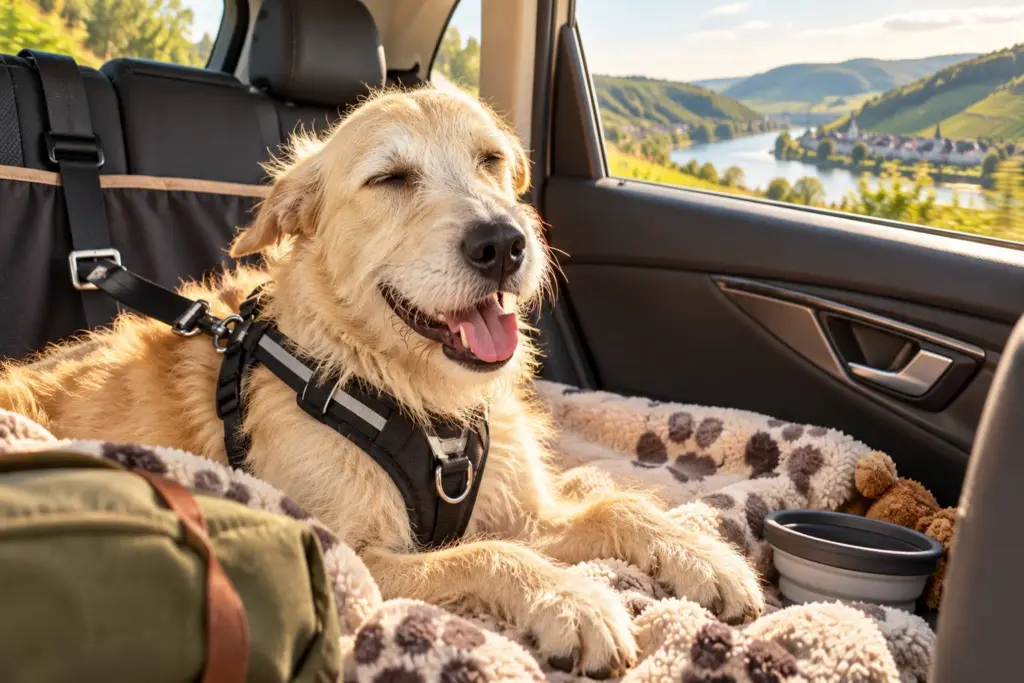
Many animals know the car only as the way to the practice. Short practice drives that end somewhere pleasant change that. The animal travels secured, in a firmly fixed carrier or in a harness attached to the seatbelt; loose in the car, it is a danger to itself and to everyone else. Into the boot go water and a bowl, a lead, waste bags, a towel, the passport and the blanket that already smells of home.
On the road, a dog needs a break roughly every two hours; a cat stays in the carrier and is offered water there. Clip the lead on before the door opens, because motorway service areas are where animals most often bolt. Keep the air moving, and keep the animal out of direct sun.
In warm weather, never leave an animal alone in a parked car, not even briefly. The inside heats up quickly, even in the shade and with the windows ajar. Heavy panting, restlessness, an unsteady gait or collapse can point to heatstroke, and that is an emergency: drive to the nearest practice immediately and have someone call ahead while you do. The same goes on any trip for breathing difficulties, suspected poisoning, a tense swollen abdomen or an injured eye: do not wait, contact a practice or the out-of-hours service straight away.
If, despite the practice runs, your animal simply never settles in the car, that is not an emergency, but it is worth raising at your next appointment.
Help outside opening hours
In Luxembourg, the out-of-hours service for small animals runs from 08:00 to 08:00 the following morning. The on-call lists are published by the Collège Vétérinaire, by the LAK under “GARDE” and by the AMVL; the general emergency number is 112. Before a trip abroad, note down a practice near where you are staying and how out-of-hours cover works there. That is easier at the kitchen table than at the roadside.
Frequently asked questions
Who issues the EU pet passport?
Your vet does, once the animal is microchipped and the rabies vaccination has been recorded. Your practice can explain how the passport is kept up to date after that.
Do I need it for a short trip to Trier or Arlon?
Take it with you. It is the document that links your animal to its chip and its vaccination record, and a short outing can turn into an unplanned visit to a practice abroad. Ask your vet in advance what applies to your route.
What helps a dog that hates the car?
Short practice drives that end somewhere pleasant, a secured carrier or harness, fresh air, no direct sun and regular breaks help many dogs. If your dog still never settles, raise it at an appointment. If an animal shows acute signs on the road, such as heavy panting in warm weather, contact a practice or the out-of-hours service immediately.
Who can I reach at night or at the weekend?
The on-call practices run a 24-hour service that starts at 08:00 and ends at 08:00 the next morning. To reach the vet on duty you can call 112 or Post Infotel on 26 77 12 34, and the on-call list is published by the Collège Vétérinaire and on amvl.lu under GARDES. Our own emergency page lists the ones on duty right now with their numbers. Call before you set off: the vet on duty may not be at the practice and has to get there too.